
FOR IMMEDIATE RELEASE Moment for Women Alliance Calls for Shift from Women as Voters to Women as Decision-Makers Ahead of Nigeria’s 2027 Elections
A non governmental organization, Moment for Women Alliance, through its Let Women Vote Nigeria 2027 Campaign, has called for stronger action by political parties, electoral institutions, lawmakers, civil society, the media, communities and development partners to ensure that women’s participation in Nigeria’s elections translates into meaningful political representation and decision-making power.
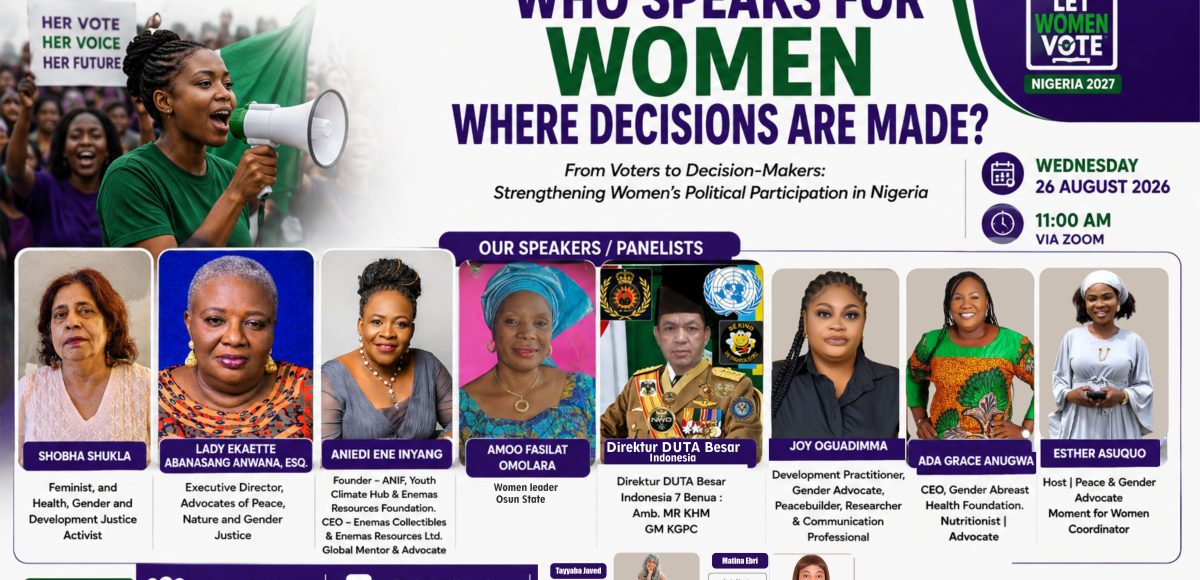
On 26 August 2026, Moment for Women Alliance, through its Let Women Vote Nigeria 2027, held a webinar, “Who Speaks for Women Where Decisions Are Made? From Voters to Decision-Makers: Strengthening Women’s Political Participation in Nigeria.” The webinar recording is publicly available on YouTube, while contemporaneous coverage confirms that the discussion examined the structural barriers preventing women’s electoral participation from translating into political power.
The conversation comes at a critical point ahead of Nigeria’s 2027 General Elections. UN Women reported in May 2026 that women then occupied just four of Nigeria’s 109 Senate seats and 16 of 360 seats in the House of Representatives, approximately 4.2% of the National Assembly. The same assessment reported that 13 State Houses of Assembly had no female members.
The webinar highlighted barriers including unequal access to political-party nominations, leadership opportunities and campaign finance; patriarchal attitudes towards women’s leadership; political intimidation and harassment; online abuse; and women’s disproportionate unpaid care responsibilities. The discussion underscored that increasing the number of women who vote is essential, but insufficient if women remain excluded from the institutions where candidates are selected, and public policy is determined.
Aniedi Ene Inyang, founder of multiple forward-thinking initiatives and the first speaker at the session, emphasized that women’s political participation must go beyond serving as mobilizers, organizers and supporters of political processes. She said Women must also have genuine opportunities to contest, lead, influence decisions and speak for themselves where political power is exercised.
Lady Ekaette Abanasang Anwana, Esq., Executive Director of Advocates of Peace, Nature and Gender Justice and the second speaker at the session emphasized that violence, intimidation, harassment and other forms of abuse continue to discourage women from participating fully in political life. While policies and institutions may exist, she said that weak implementation, inadequate protection and limited accountability remain major concerns.
Gender-justice advocate Shobha Shukla, Founder and Executive Director of Citizen News Service, as a third speaker whose participation in the session is independently confirmed by contemporaneous coverage, argued that women must be able to speak for themselves and build wider support for their political voice. Her documented intervention emphasized that representation must involve real agency and influence, rather than token inclusion.
“Nigeria cannot continue to depend on women as voters, organizers and mobilisers while women remain largely absent from the places where candidates are selected, laws are made, and public resources are allocated. As we move towards 2027, our focus must be on creating practical pathways that enable women to move from participation to representation, from voters to candidates, elected leaders and decision-makers.” Said Ms Esther Asuquo, Moment for Women Alliance Coordinator.
The call is consistent with reforms already under discussion nationally. INEC has identified gender inclusion as important to credible and inclusive elections and has previously encouraged political parties to address discriminatory nomination practices and affirmative action. Ahead of 2027, the Commission has also said its review of political-party regulations is giving particular attention to measurable benchmarks for the participation of women, young people and persons with disabilities within party structures.
Moment for Women Alliance believes the period before nominations and party primaries is particularly important. Political parties should establish transparent and inclusive nomination systems, expand women’s participation in party leadership, support women candidates with practical training and access to political resources, and institute strong safeguards against discrimination, intimidation and harassment. Civil-society organizations and development partners should complement this work through candidate-development programmed, legal and policy advocacy, digital safety support, public monitoring and sustained engagement at national, state and grassroots levels. These recommendations are consistent with current Nigerian initiatives focused on candidate preparation and responses to gendered disinformation and online harassment.
The full webinar recording can be viewed at:
Esther Asuquo
Coordinator, Let Women Vote Nigeria 2027
Moment for Women Alliance
Email: info@momentforwomen.org
Leave a Comment